Chicago Monuments Panel Urges Removal of Columbus Statues and Other Works, Leaving Mayor to Decide
A long-delayed report from the Chicago Monuments Project recommends taking down several statues and plaques and funding new memorials, but Mayor Lori Lightfoot is not bound to act on it.
By Ken Adams ·
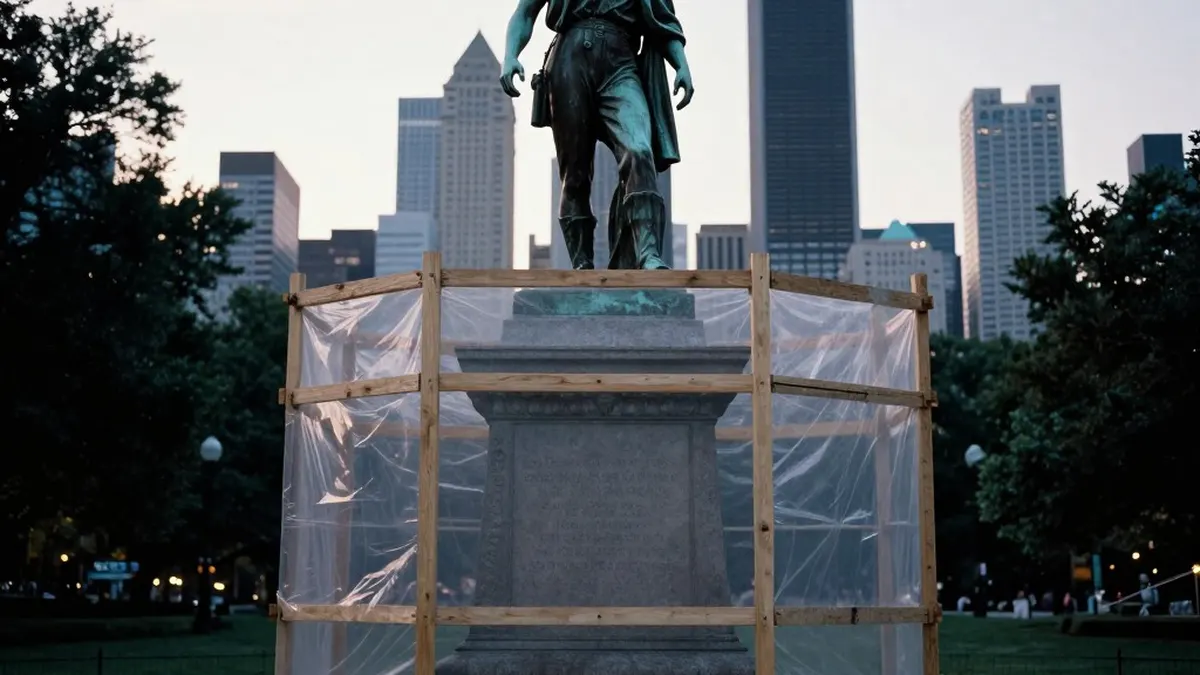
A committee appointed by Mayor Lori Lightfoot to review Chicago's public monuments released its long-delayed report this week, recommending that the city remove several works, including statues of Christopher Columbus, and commission new memorials across the city. The mayor, who has previously said the Columbus statues should return to public view, is not required to follow any of the recommendations.
Lightfoot launched the Chicago Monuments Project two years ago, after a violent clash between police officers and protesters over a prominent Columbus statue. She described the effort as "a racial healing and historical reckoning project." Columbus was under renewed scrutiny at the time as statues were pulled down around the country and local governments stopped marking the holiday in his name. Chicago removed its monuments, but Lightfoot initially resisted doing so and later said the Grant Park statue should eventually be returned, saying she does not believe in sanitizing history. An Italian American group also sued her over the removal of another Columbus statue in Little Italy.
The panel's work extended well beyond Columbus. It called for removing the Jacques Marquette-Louis Jolliet Memorial, saying it reinforces stereotypes about American Indians and shows a cowering Native figure following submissively behind Marquette. It also recommended removing a statue honoring the Supreme Court chief justice who presided over Plessy v. Ferguson, the ruling that enshrined segregation.
Plaques honoring early settlers John Kinzie and Jean Baptiste Beaubien were also flagged. The report said the Kinzie plaque openly prioritizes whiteness and denies the existence of Native peoples and of settler Jean Baptiste Point DuSable. Reliefs on the DuSable Bridge, including The Defense, The Pioneers, Discoverers and Regeneration, were listed for removal because they portray American Indians as a foil for colonizing forces, though the panel acknowledged that would be difficult because they are built into the bridge. Tablets for explorers La Salle, Jolliet and Marquette were included as well, one of which the report said voices an ideology of white supremacy. The commission also targeted a monument to Italo Balbo, calling it a gift of Italy's fascist government.
On the constructive side, the panel proposed $50,000 grants to artists to develop ideas for new monuments. Suggested subjects include Pilsen Latinos, Mahalia Jackson, the Mother Jones Heritage Project, and DuSable and his wife Kitihawa, a local Potawatomi woman. The report also backs memorials for the Chicago Torture Justice Memorial, the 1919 Chicago race riot, a visibility project for Black women and girls, and a community-led monument to victims of gun violence.
A third category covers works to be revised or given added context, including the Standing Lincoln, Seated Lincoln, Lincoln Rail Splitter and Young Lincoln statues. Some have criticized Abraham Lincoln over his treatment of Indigenous people, including authorizing the mass execution of Dakota Sioux people. Monuments to John Logan, Benjamin Franklin, Leif Ericson, La Salle, Ulysses S. Grant and George Washington, along with several works depicting Indigenous people and various historic markers, also fall into this group. The committee said more community engagement is needed before decisions on those structures, but urged that accompanying texts be revised now.
The report was released without the customary statement from Lightfoot. Her office later thanked the committee but did not say which recommendations she would adopt. She said the history of both Native and Italian American communities is intrinsic to Chicago's story and promised more dialogue and public engagement. Committee co-chairs Mark Kelly and Bonnie McDonald said they believe the recommendations will make the city's public art more honest and inclusive.
Reaction was split. Ald. Nicholas Sposato, 38th, who served on the commission and is Italian American, said he had not read the full 73-page report but declared, "I'm not a revisionist." He said removing Columbus would upset people because the explorer represents Italian Americans coming to the country. The report also includes an essay by Sergio Giangrande, a former president of the Joint Civic Committee of Italian Americans, who argued against storing the statues and questioned the precedent for other groups' monuments.
Les Begay, a Rogers Park resident, citizen of the Diné Nation and founder of the Indigenous Peoples Day Coalition of Illinois, welcomed the recommendation but said it would be "just for show" if the mayor overrode it. He said Native people have been erased from history and that not returning the statues tells people "we still exist." Professor John Low, in an essay in the report, wrote that "monuments are not innocent" and can perpetuate narratives that favor one view of the past over others.
Originally published by News Media House · Source: Chicago Tribune